
58 Rare Medical Cases
The work "Collection of Outstanding Clinical Case Reports" gathers 58 rare, challenging medical case reports, helping young doctors draw clinical lessons, and has been nominated for the 2025 National Book Award.
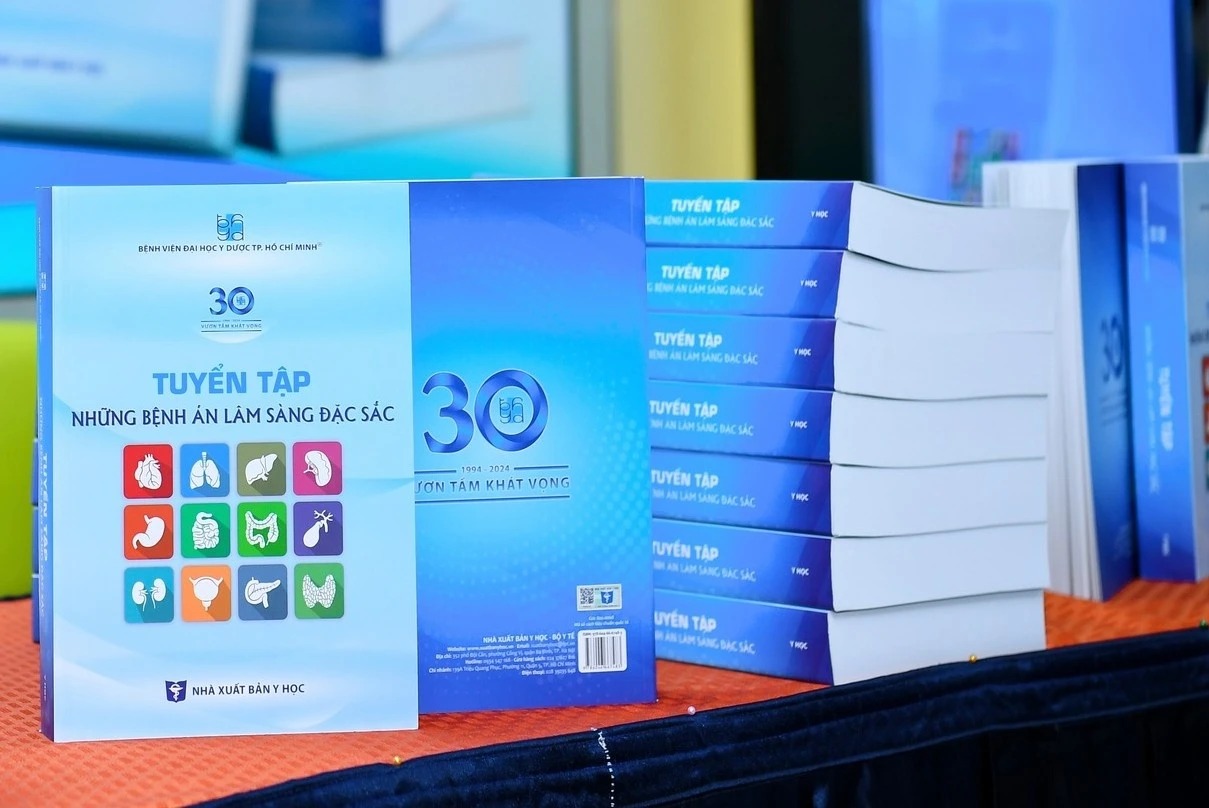
The collection of outstanding clinical case reports emerges as an impressive medical work combining practice and scholarship, documenting 58 cases of special teaching and reference value. Compiled by leading physicians at the University Medical and Pharmacy Hospital of Ho Chi Minh City, the book not only contributes to training a generation of excellent clinical physicians but also brings Vietnamese medicine closer to international standards.
Tri Thức - Znews conducted an interview with Associate Professor Dr. Lê Minh Khôi - Head of Science and Training Department at the University Medical and Pharmacy Hospital of Ho Chi Minh City - Head of the editorial board. This is also the sole academic medical work included in the nomination list for the 2025 National Book Award.
The "life-and-death" work for medical progress
- Sir, what was the impetus for the creation of the “Collection of Outstanding Clinical Case Reports”? How long has this project been undertaken and what effort did it require?
- While studying at medical school or while practicing, physicians are always taught and hold the belief that there is no disease, only disease in each specific patient. This saying means that even with the same diagnosis (for example, acute appendicitis), each individual patient will have different manifestations, diagnosis, treatment, and prognosis.
The distinguishing point of this book is that the disease cases described are specific cases with different manifestations and courses in Vietnamese patients, under Vietnamese conditions. Associate Professor Dr. Lê Minh Khôi
There is no pathology textbook that can teach doctors all the myriad clinical manifestations of diseases. Hải Thượng Lãn also once referred to the 'Positive cases' (successful treatment cases) and 'Negative cases' (misdiagnosed or improperly treated cases) in the training of medical students. Therefore, the disease cases, which we call clinical case reports here, are stories containing extremely valuable real-world material for learners.
The University of Medicine and Pharmacy Hospital in Ho Chi Minh City, with a leading team of experts and a pioneering electronic medical record system, has greatly helped learners. Every week, we hold a hospital-wide professional briefing to analyze interesting and challenging case studies for young doctors and trainees. Through such professional analyses, we realized the need to disseminate this knowledge more widely, not just within the scope of a briefing. That is the idea that gave birth to the book. Under the direction of Associate Professor Dr. Nguyen Hoang Bac - Hospital Director, the Science and Training Department organized the implementation of this idea.
If we talk about the timeline, the book was completed within a year from conception to printing as a project commemorating the hospital's 30th anniversary. However, the data source for these clinical case records had already been collected by the editorial groups beforehand. When the editorial board requested to compile the clinical case records, the groups began writing in a unified, standardized format. And how much effort was involved? Anyone can hold the book in their hands, look at the collective editorial team from all participating specialties, and understand the dedication we have poured into this book.
- What are the similarities and differences of the book compared to similar works compiled worldwide?
- Any book, whether in Vietnam or worldwide, to be a valuable reference must select distinctive case studies, accurately describing signs and symptoms, the “deceptive” manifestations that obscure diagnosis, progression, treatment, outcomes, and lessons learned from that specific case. Of course, the reference material must be standardized, reputable, and up-to-date.
The distinction of this book lies in the fact that the disease cases described are specific cases with varying manifestations and courses in Vietnamese patients, under Vietnamese conditions. No two patients are alike, so there will be no two identical clinical case records.
We set the selection criteria that those case records must truly be “remarkable” both in rarity, atypical progression, featuring signs and symptoms that mislead physicians in diagnosis, or difficult surgical interventions that we have successfully performed. In short, each case must have some distinctive aspect for learners to draw their own experiential lessons.
- Vietnam now has many medical sub-specialties, treatments that patients worldwide seek out. How does strengthening clinical research have practical significance?
- Research (basic, epidemiological and clinical) is a life‑or‑death task for the progress of medicine worldwide and in Vietnam in particular. The days are gone when each medical facility claims to be good in one specialty, excellent in another without scientific data to substantiate it. To compare with the world we must have data. To have data recognized we need to use widely accepted scientific standards. To be known by the world we must have publications. Publication can be as simple as participating in clinical data networks (in the field called registry studies) for comparison.
However, at a higher level, we need clinical studies that are rigorously designed, scientific, with appropriately processed data, and arguments that are examined in the light of scientific evidence. From that, publications will be accepted. Such publications, besides contributing to the body of human knowledge, also put the Hospital, School or Research Institute on the international scientific map.
Therefore, in recent years the Hospital has issued policies and organized activities to promote clinical research. As a result, the number of scientific papers from the Hospital published in reputable international journals has increased dramatically. Some outstanding clinical case reports in this book have also been published in international journals as Case Reports.
Doctors go making books
- When moving from the role of a treating physician to that of a writer and book editor, he found that the thing he had to change most in reviewing a case was?
- Language is the material clothing of thought. Writing is a deep thinking process that requires many skills. Writing up a case also positively impacts the physician's thought process. Therefore, presenting clinical cases is an indispensable professional activity in any hospital.
To present a good clinical case at the department or hospital level, or to write a clinical case report for inclusion in a reference book, many factors are required, but there are certainly some essential aspects.
First, it is the power of observation. Observational analysis is the source of science. Signs and symptoms are highly varied, can be vague, hidden, or overlap with those of other diseases. In observation, the physician must carry out the processes of questioning, looking, touching, tapping, and listening. From these observations, the physician makes preliminary diagnoses. Based on that, further tests are ordered, after which a comprehensive diagnosis can be made. Without observational skills, one certainly cannot be a good physician.
Second, we must record signs and symptoms as honestly as possible. Do not force symptoms to fit the initial diagnostic direction.
- Besides professional knowledge, what other message does he wish to convey to young doctors through this work?
Language is the material coat of thought. Writing is a profound thinking process that demands many skills. Writing a case report also positively influences the physician’s thought process. Assoc. Prof. Dr. Lê Minh Khôi
- In the introduction of the book, I quoted Dr. Osler: a medical student without books is like sailing a boat into an uncharted sea without a compass, and a medical student without patients never reaches the sea.
The first half emphasizes the importance of books. The second half speaks to the essential core of the medical profession: clinical practice. A learner who does not get involved in the ward, who does not deeply engage with patients' manifestations will find it difficult to learn anything, let alone become a good physician. With the emergence of artificial intelligence (AI), academic knowledge can be obtained with a click. However, experience and clinical sensitivity cannot be supported by any AI. And that is also the point where humanity in the future will still need truly excellent clinicians with empathetic hearts toward patients.
- What does the nomination of the book for the 2025 National Book Award mean for you personally and for the editorial team?
- This is a great encouragement, a huge source of motivation even though we did not write the book aiming for an award. It can be seen as an official recognition from the community for our silent efforts.
On behalf of the editorial board and the collective authors of the book, I sincerely thank the National Book Award judges for favoring this very deep and seemingly dry specialized book. The award will also give us additional strength and confidence to continue the upcoming book compilation work for the Hospital, not limited to clinical case reports.
Thank you, Associate Professor, for taking the time!