
After the lead apron
The phone from the Emergency Department rang, shattering the silence in the Intracoronary Intervention Unit. An urgent voice announced: “Male patient, 40 years old, acute inferior myocardial infarction, at risk of cardiac arrest.”
Immediately, like a reflex ingrained in every medical staff member, the team hurriedly prepared for the emergency case requiring coronary revascularization. Each movement was practiced, precise, racing against time to save the patient's life.
Pressure becomes motivation
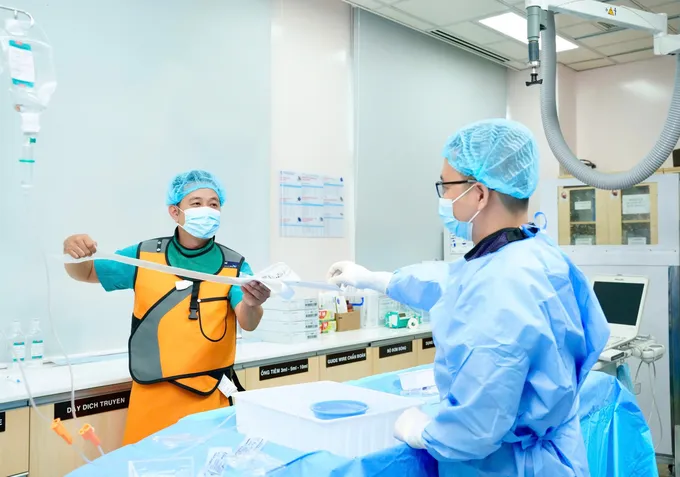
Only five minutes later, the patient arrived at the DSA suite (digital subtraction angiography room). The patient was experiencing severe chest pain, shortness of breath, and was in distress. Wearing a heavy lead apron, nurse Lâm Minh Khánh Hoàng both encouraged the patient and closely monitored the electrocardiogram and blood pressure.
Noticing an abnormal heart rhythm, he immediately alerted the doctor, with medication ready in hand for intervention. “A single second of delay could cause the patient to go into cardiac arrest right on the intervention table,” he shared.
Critical situations are not uncommon in the work of nurse Khánh Hoàng over the past 13 years at the Endovascular Intervention Unit, University Medical Center, Ho Chi Minh City. Not only is he an outstanding staff member of the unit, but recently he also achieved the highest score in the master’s program admission exam for Nursing at the University of Medicine and Pharmacy, Ho Chi Minh City.
“Studying for a master’s degree in the upcoming period will help me realize my desire for teaching and scientific research. In the medical field, advancing expertise also aims at the highest goal: the health of patients,” he shared.
Profession and vocation after the lead apron
Prof. Dr. Trần Hòa, Head of the Endovascular Intervention Unit, University Medical Center, Ho Chi Minh City, commented: “Nurse Lâm Minh Khánh Hoàng is a model party member, an outstanding staff member of the unit, but Hoàng’s journey to the profession has not been easy.”
In 2009, after graduating from Phạm Ngọc Thạch Medical University, Hoàng began working at a specialized hospital in Ho Chi Minh City. Less than a year later, he received a conscription order, set aside his career and fulfilled his duty to the nation. His days in the army forged in him a spirit of discipline and a willingness to face difficulties.
Discharged in 2012, he officially joined the University of Medicine and Pharmacy Hospital in Ho Chi Minh City, assigned to the DSA department. At first, concerns about the risk of X‑ray exposure and pressure from emergency patients made him uneasy. Nevertheless, seeing many brothers and sisters devoted to saving lives, Hoàng believed that he could do it too.
Since then, Hoàng has attached his profession to the lead apron, which is how he takes on responsibility together with the team to treat and save patients. Staying at the hospital after each shift, Hoàng observes how the instruments are prepared, how complications are handled, and how patients are reassured.
“You have to operate quickly and accurately while wearing a lead apron that weighs nearly 8 kg, which is not easy. On my first day in the cath lab, I was so exhausted that I went home to sleep soundly because I was ‘dizzy from the rays,’” he recalled. A week later, his body gradually adapted to this specialized work.
In reality, the working environment in the DSA suite is highly challenging. Staff must wear lead aprons to protect against X‑rays and wear dosimeters to monitor exposure levels. If the absorbed radiation exceeds the limit, they are required to rest to ensure safety.
According to Associate Professor Dr. Trần Hoà, long‑time practitioners of this profession are prone to occupational diseases such as back pain, knee joint pain, bilateral venous insufficiency, and a potential risk of cancer related to X‑ray exposure.
Unlike treating physicians, interventional nurses mainly appear in life‑or‑death situations such as myocardial infarction, stroke, emergency resuscitation... but they are rarely remembered by patients or called by name.
“Nurses, technicians, assistants, and doctors are all important. Every step must be professional, with skilled personnel, and coordinated cooperation to achieve effectiveness. No one plays a secondary role in the intravascular intervention team,” Dr. Tran Hoa shared.
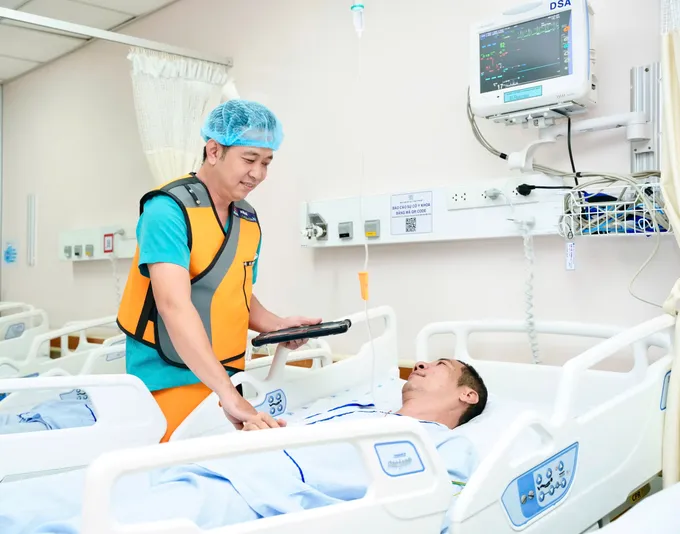
“In fact, whether patients remember me or not is not that important. The greatest joy is the moment a patient escapes death. Over the past 13 years, that feeling remains intact, and it is the biggest motivation for me and my colleagues to stay committed to the profession,” nurse Khanh Hoang confided.
The regular on‑call work is stressful and demanding, but it is also a fortunate bond. After all, his wife is a nurse working at the University Medical and Pharmacy Hospital in Ho Chi Minh City. This support gives him extra motivation to stay attached to the profession.
“My wife is a nurse working in the Anesthesia and Intensive Care unit. We share empathy for night shifts, those tense moments racing against time to save patients. We met through patients, and our youth is tied to the hospital!,” nurse Lam Minh Khanh Hoang cheerfully recounted.
Lessons from crises and empathy with patients
There have been many times when nurse Khánh Hoàng faced strong reactions from patients and their families. Especially in emergency situations, overload, patients have to wait a long time or have program procedures postponed. When he first started his career, he only knew how to suppress his emotions, reminding himself to fulfill his duty.
It was only when a crisis struck—his father was diagnosed with cancer—that he realized the bewildered, anxious feelings of patients. From that incident, he became more patient, putting himself in others' shoes to empathize and share.
With his experience and dedication, nurse Khánh Hoàng now serves as an instructor for young nursing classes. He also pioneers management and quality improvement work at the Endovascular Intervention Unit.
Recently, he and his colleagues successfully built a quality management system according to ISO 9001:2015 standards, and also proposed many initiatives to optimize administrative processes in the unit.
According to Prof. Dr. Trần Hoà, these improvements have contributed to enhancing efficiency and professionalism at the Intracardiac Intervention Unit – one of the “leading edge, pioneering” places of the University of Medicine and Pharmacy Hospital, Ho Chi Minh City. As for nurse Khánh Hoàng, nursing is not only a job but also a continuous learning journey for the sake of patients.
News Link: https://www.sggp.org.vn/sau-chiec-ao-chi-post783085.html