
Pioneers split liver leaves to double life
Famous from a relatively young age for his breakthroughs in laparoscopic hepatobiliary surgery, Dr. Tran Cong Duy Long, Head of the Hepatobiliary Cancer and Liver Transplant Unit, Deputy Head of the Department of Hepatobiliary Surgery, Saigon University of Medicine and Pharmacy Hospital, is also one of the pioneers in separating donor liver lobes for transplantation into two recipients, doubling lives.
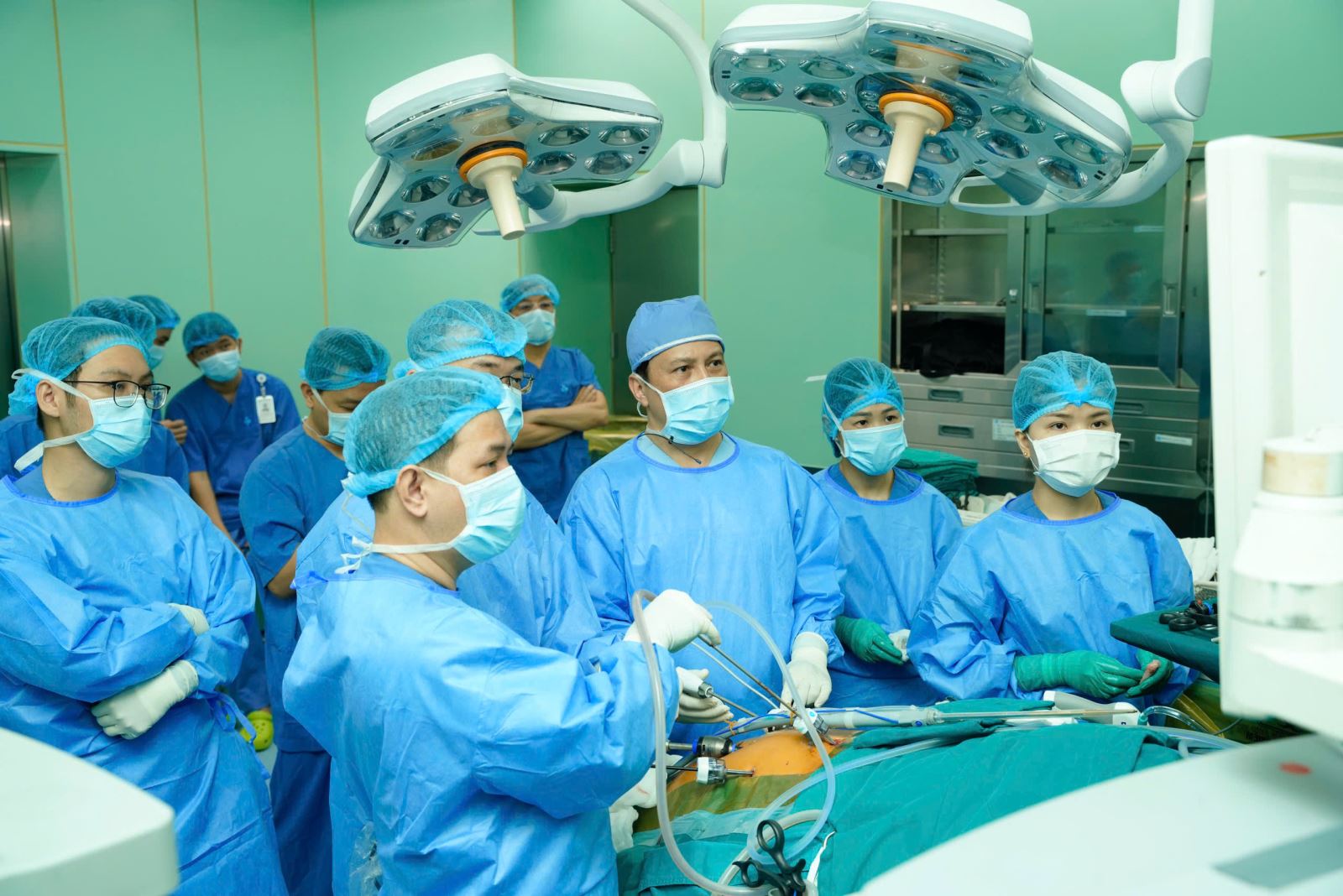
Striving to bridge the gap with world medicine
Graduating from the residency program in surgery at Ho Chi Minh City University of Medicine and Pharmacy in 2004, Dr. Tran Cong Duy Long joined the Hospital specializing in liver, gallbladder, and pancreas. The first turning point in his life was an intensive study trip to Taiwan (China).
“When I went there, I was truly amazed by the development of hepatobiliary surgical techniques; they were far more advanced than us. At that time, standing at the hospital gate, I was concerned, they were at a very high level, how could we narrow this gap?” Dr. Long shared.
Fortunately, at that time, at Saigon University of Medicine and Pharmacy Hospital, laparoscopic surgery was developing strongly; meanwhile, in developed countries, liver surgery still adhered to traditional open surgery.
Dr. Long thought of using laparoscopic surgical techniques in liver‑biliary surgery. With the support of the hospital leadership, Dr. Trần Công Duy Long set out to implement it and succeeded beyond expectations. Since then, liver‑biliary surgery at the University of Medicine and Pharmacy Hospital in Ho Chi Minh City has developed dramatically, and by 2013, when reporting at international conferences, Dr. Long received commendation from colleagues worldwide.
In 2017, at the 1st World Laparoscopic Liver Resection Conference in France, a Vietnamese doctor won the “Best Laparoscopic Liver Resection Video” award for the first time.
“Medicine constantly advances; anyone who does not learn falls behind.” Recognizing this, Dr. Trần Công Duy Long continuously accumulates experience and learns to become ever more refined and progressive.
He reflects: “Even though we have an advantage in laparoscopy for liver resection, the medical field in developed countries advances like a whirlwind because they have many advantages. When they progress, we must also move forward, improve technically, create new innovations; otherwise we will fall behind.”
After succeeding with laparoscopic liver resection techniques, the University of Medicine and Pharmacy Hospital in Ho Chi Minh City began implementing organ transplantation techniques, including liver transplantation.
According to Dr. Long, in Vietnam, the rate of people infected with hepatitis B and hepatitis C is very high due to poor vaccination practices in the past. As a result, the number of people with cirrhosis and liver cancer is increasing, and treatment cannot be definitive; only liver transplantation can improve this problem.
Each year, at the University of Medicine and Pharmacy Hospital in Ho Chi Minh City, there are about 1,000 liver cancer cases that need monitoring and treatment, and this number is steadily increasing. As a key player in receiving technology transfer from Korean colleagues, in 2018 Dr. Tran Cong Duy Long performed the first adult liver transplant. Mastering liver transplantation techniques at the University of Medicine and Pharmacy Hospital in Ho Chi Minh City and domestic transplant centers is highly significant, allowing patients with liver failure or cirrhosis to avoid going abroad at great cost. The time, surgical costs, travel, and living expenses are greatly reduced, and patients find it more convenient during recovery care and post‑transplant follow‑up.
Finding a chance to live from the “narrow thresholds”
When adult liver transplantation has become routine at the University of Medicine and Pharmacy Hospital in Ho Chi Minh City, it is also the time when Dr. Tran Cong Duy Long began receiving many children with cirrhosis and congenital bile duct atresia.
“More and more people bring their children to me for treatment. I was very surprised when I received those children with yellowish skin, swollen bellies. In the early days, when pediatric liver transplantation in Vietnam was not yet developed, I was deeply pained seeing the children die one after another before my eyes. This haunted me and I told myself that I must find a way to save these children,” Dr. Long recalled hoarsely.
To act on it, Dr. Trần Công Duy Long proposed that the hospital leadership coordinate with Children Hospital 2 to perform liver transplants for children. With the experience and expertise of the medical teams of both hospitals, in the context of COVID-19 restrictions on travel, the doctors were even more determined to master the pediatric liver transplantation technique themselves.
In 2020, for the first time, the medical team of Children Hospital 2 and the University of Medicine and Pharmacy Hospital in Ho Chi Minh City successfully performed a pediatric liver transplant without any assistance from foreign experts.
Recalling this proud milestone, Dr. Trần Công Duy Long's eyes sparkled with joy: “The pediatric liver transplant performed entirely by the Vietnamese medical team holds immense significance for us; it makes us more confident to continue transplanting livers for children, saving these young lives.”
After many years of pediatric liver transplants, Dr. Long noticed that children only need a small piece of liver to have a chance of being saved. Usually, when transplanting a liver from a brain-dead donor, most doctors take the whole liver lobe for transplantation, but having performed transplants in both children and adults, he thought about splitting the donated liver lobe to transplant into two people, the larger part for an adult and the smaller part for a child. This means that a single donated liver lobe from a brain-dead donor can provide a chance of life for two people.
With the support of hospital leadership and the National Organ Transplant Coordination Center, in August 2024, from the liver of a brain-dead male donor, Dr. Trần Công Duy Long harvested the liver and split it into two parts to transplant into a 53-year-old man with liver cancer and a 9-month-old girl with primary biliary cirrhosis.
The transplants were brilliantly successful, and the two patients were discharged shortly thereafter. "The surplus rises", in November 2024, when news arrived of another brain-dead donor case at Thống Nhất Hospital, Dr. Trần Công Duy Long and PhD, Dr. Ninh Việt Khải (Việt Đức Hospital, Hanoi) performed a split of the donor’s liver into two parts, one part was sent to Việt Đức Hospital for an adult transplant, and the remaining part was taken by Dr. Trần Công Duy Long to the University of Medicine and Pharmacy Hospital in Ho Chi Minh City for a 3-year-old pediatric patient.
“Truly I cannot fully describe my emotions and those of my colleagues after the two successful liver split transplants. We have fully utilized the precious gift from organ donors to save another life,” Dr. Long shared.
Having been involved in the medical field for over 20 years, Dr. Trần Công Duy Long continuously learns to master medical advancements, creating new milestones, laying a foundation for the next generation to inherit and develop. On his medical career path, Dr. Long has also witnessed many times the fragile boundary between life and death. What makes this doctor happiest and most proud is helping patients escape death, holding onto life.
Report Link: https://baotintuc.vn/y-te/nguoi-tien-phong-chia-tach-la-gan-de-nhan-doi-su-song-20250226135247638.htm