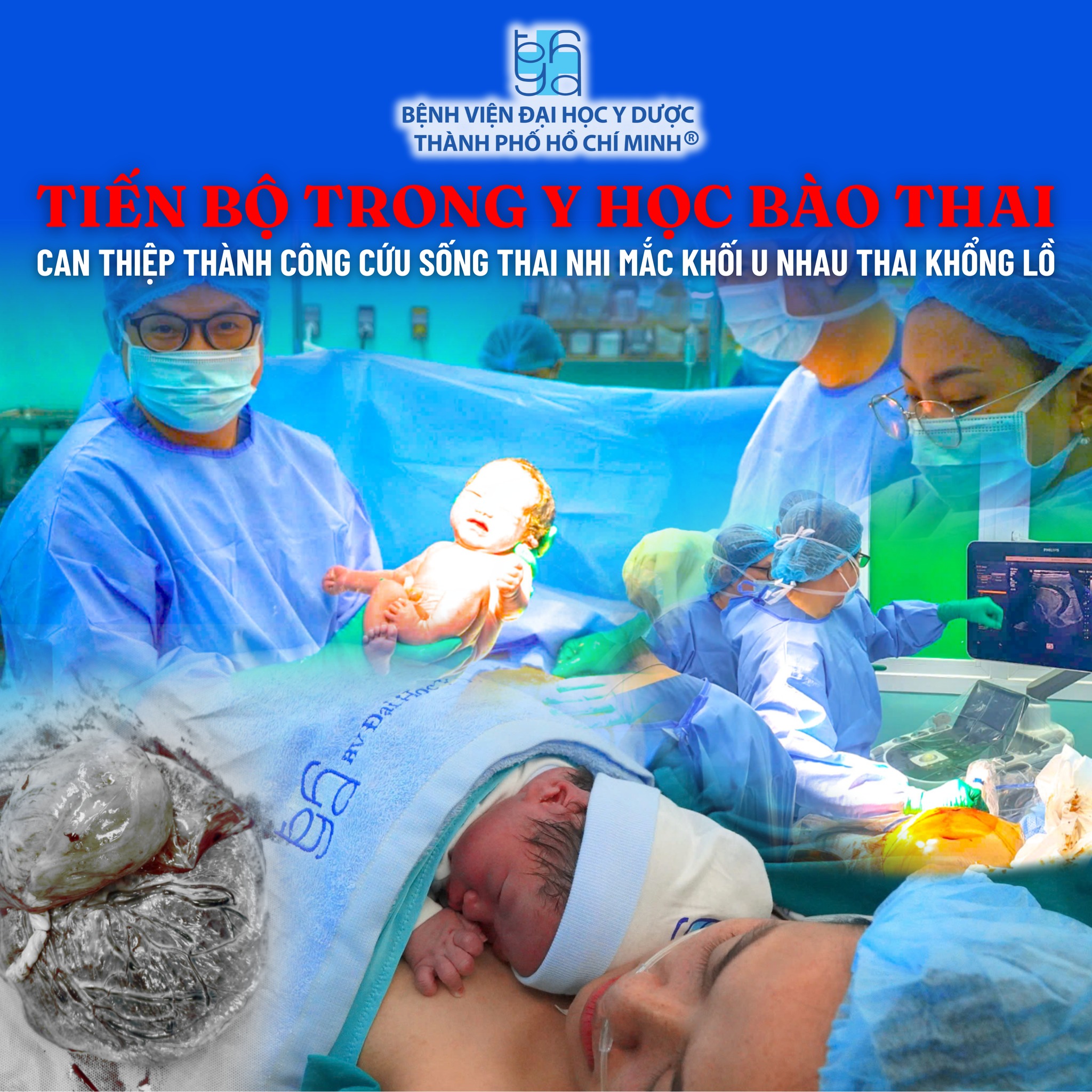
Advances in fetal medicine: Successful intervention saves a fetus with a massive conjoined fetal tumor
A fetus was saved directly from the mother's womb thanks to an extremely rare and complex intervention procedure, successfully performed for the first time at the University Medical and Pharmacy Hospital of Ho Chi Minh City (BV ĐHYD). This is a significant milestone, affirming the hospital's expertise in the field of fetal medicine – obstetrics and gynecology, a relatively new specialty in Vietnam.
A young, first-time pregnant woman visited BV ĐHYD for an examination when the fetus was at 28 weeks, presenting with shortness of breath and fatigue. Through fetal cardiac ultrasound, Associate Professor Dr. Lê Minh Khôi – Head of the Cardiac Imaging Unit, discovered a critical condition: “The fetus had pericardial effusion, severe heart failure, and simultaneously a massive conjoined fetal tumor. This tumor proliferated blood vessels, increasing blood flow to the fetal heart, leading to circulatory overload and heart failure. This is a dangerous clinical situation, pushing the fetus into a ‘thousands of pounds hanging by a hair’ state.”
Meanwhile, the fetus was only 28 weeks old, a premature threshold that carries many risks if born early. Associate Professor Dr. Trần Nhật Thăng – Head of the Obstetrics Department, stated: “Preterm birth at this stage can lead to serious complications such as neonatal infection, cerebral hemorrhage, necrotizing enterocolitis. However, after daily monitoring of the progression, we found that further delay was not possible.”
Facing the urgent situation, the Hospital quickly established a specialist council comprising doctors from the obstetrics, cardiology, imaging - vascular intervention, and functional departments, under the direct direction of the Board of Directors. The entire team unanimously chose the approach: Vascular intervention to block the blood vessels feeding the tumor within the uterus with the goal of relieving pressure on the fetal heart and extending the pregnancy by at least 4 weeks.
Associate Professor Dr. Võ Tấn Đức - Head of Imaging Department said: “Normally, intravascular interventional procedures are performed under X‑ray guidance. However, in this case, to protect the fetus from radiation exposure, the entire procedure must be performed under ultrasound guidance. Inserting a needle through the abdominal wall into the uterus of the pregnant woman to precisely locate and access the main blood vessel of the tumor requires very high accuracy, coordinated teamwork, and extensive experience of the interventional team.”
Initially, the team used a coil (small metal spring) to block the tumor's blood vessels. However, due to the large blood flow, the flow could not be completely blocked. In this situation, the team made a pivotal decision to use a bio‑glue to fill the gaps around the coil and blood vessels. This procedure requires near‑absolute precision, because if the bio‑glue follows the blood flow into the fetal heart or brain, the risk of blocking important vessels is very high and the consequences could be fatal.
The results exceeded expectations; after the intervention, blood flow to the fetal heart decreased rapidly, the tumor shrank, and the fetal heart condition recovered. The pregnancy continued not only up to the expected 32 weeks, but extended to 39 and a half weeks, and the baby was born safely without any emergency interventions. Currently, the baby is less than 4 months old, in stable health, developing well, and is being monitored regularly postpartum.
Sharing about a challenging journey, Ms. T.N.B (born 1995, residing in Ho Chi Minh City) emotionally said: “When I was informed about the critical condition of the fetus, although the doctors explained in detail, I could not hide my worry and fear because this was a technique being applied for the first time, with many risks. But I told myself that if I didn't try, I might regret later. Therefore I trusted the medical team and decided to accompany the intervention plan. I would like to express my deepest gratitude to the doctors of the University of Medicine and Pharmacy Hospital in Ho Chi Minh City. The dedication, solid expertise, and courageous spirit of the doctors have given my child a chance to live. I hope this successful case will open new advances for fetal medicine in Vietnam, helping many other families have hope like we do today.”
Associate Professor Dr. Nguyen Hoang Bac – Hospital Director comments: “This is not only a professional success, but also evidence of the spirit of unity, resilience, and a heart full of responsibility of the medical professionals. We do not choose the easy path, we choose the right one. The success of multidisciplinary collaboration has contributed to the development of fetal medicine in Vietnam.”
With close cooperation, a proactive spirit, and dedication, the medical staff of ĐHYD Hospital have affirmed the mission of preserving life—from the most fragile moments of the beginning.